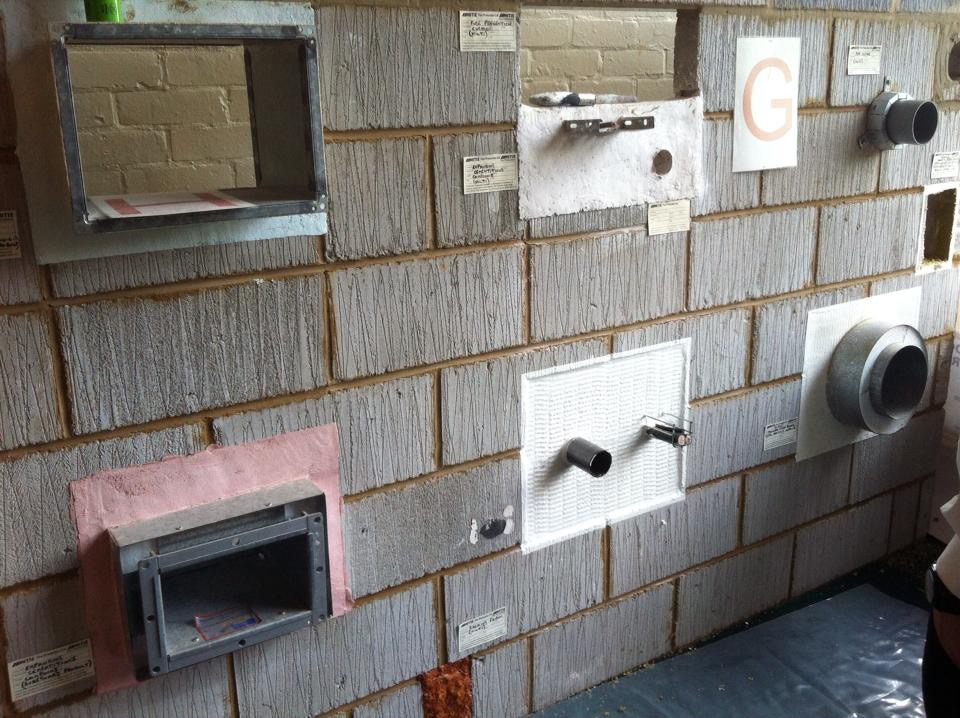

Fire dampers stop fire and smoke spreading through ductwork where it passes through fire-resisting walls and floors. If a damper is missing, blocked, damaged or cannot be reached, the building’s fire compartmentation is compromised, often without anyone knowing. Our fire damper inspection service gives you a clear, photographic record of every damper in your building, its condition and any action needed.
What our inspection covers
- Locating and identifying every fire damper, cross-referenced to drawings where available
- Checking each damper is labelled and has a unique asset reference
- Checking access: access panels present, undamaged and reachable
- Visual inspection of the blade, fusible link, frame and fixings for damage, corrosion, debris or obstruction
- Checking for visible gaps in the fire stopping around the damper where it passes through the wall or floor
- Photographs of each damper and any defects found
What you receive
- An asset register of every damper inspected, with its location and photograph
- A clear status for each damper: satisfactory, advisory or defective
- A list of defects with recommended remedial works
- A report suitable for your fire risk assessment, insurer and audit records
Inspection only
Our service is a visual inspection. We do not drop test, reset or repair fire dampers. BS 9999 recommends that fire dampers are also drop tested at least annually, and more often in some environments such as kitchens and healthcare. Where testing or remedial work is needed, our report sets out exactly what is required so it can be carried out by a specialist damper contractor.
Who needs fire damper inspections
Any non-domestic building with ventilation or air-conditioning ductwork passing through fire compartment walls or floors, including schools, colleges and universities, offices, healthcare and care settings, residential blocks, retail and industrial premises. Under the Regulatory Reform (Fire Safety) Order 2005, the Responsible Person must make sure fire safety measures such as fire dampers are maintained in efficient working order.
Why choose A&E
- Fire safety specialists since 1965 and a Royal Warrant holder
- Combine damper inspections with your fire alarm, emergency lighting and fire door inspection visits: one contractor, one visit, one set of records
- Free site survey and fixed-price quotation
Customers also ask:
-
What is included in a fire damper inspection?
We locate and identify each damper, check access and labelling, and visually inspect its condition and installation. You receive a report with photographs, a status for each damper and any recommended remedial works.
Our inspection is visual only and does not include drop testing or resetting.
-
Who is responsible for fire damper inspections?
The Responsible Person for the building must make sure suitable fire safety arrangements are in place, including the inspection and maintenance of fire dampers where they are installed.
This may be the building owner, employer, landlord, managing agent or facilities manager, depending on how the premises is managed. Using a competent contractor helps make sure dampers are inspected and recorded correctly.
-
Why Is Fire Damper Access Important?
Fire dampers must be accessible so they can be inspected, tested, maintained, and repaired when required.
If a damper cannot be accessed, it may not be possible to confirm whether it is working correctly. This can create compliance issues and may affect the building’s fire compartmentation.
Where access is poor or missing, additional access panels may be required. -
What happens if a defect is found?
Every defect is recorded with a photograph, its location and a recommended remedial action. Where a damper needs drop testing, resetting or repair, the report gives a specialist damper contractor everything they need to carry out the work.